Showing posts with label polls. Show all posts

Wednesday, May 28, 2025

King opens Parliament – Canadians don't care

In an historic first, King Charles III flew to Ottawa this week to open Canada's new Parliament and read the Throne Speech. More than four out of five Canadians polled said they didn't care. 

Royally Indifferent: 83 per cent of Canadians say they ‘don’t care’ that King Charles will deliver throne speech | Angus Reid Institute: (news release):

May 26, 2025 – "While Prime Minister Mark Carney’s now-accepted invitation to King Charles to read the throne speech opening Canada’s 45th parliament may have been politically intended to leave U.S. President Donald Trump gobsmacked, Canadians themselves are raising little more than an arched eyebrow at the visit. A new public opinion poll from the non-profit Angus Reid Institute shows a whopping 83 per cent of Canadians say they are 'indifferent' or 'don’t care' about the monarch’s historic visit, where Charles will read the throne speech – which will outline the Carney government’s priorities for the upcoming parliamentary session....

"This week’s official visit to Canada by King Charles III represents a mixture of realpolitik, the unprecedented and the ordinary. It is Charles’ 20th visit to Canada, but his first as monarch. The occasion also marks the first time in 47 years that the sovereign has read a Canadian speech from the throne.   

"As to the motivations of the invitation to His Majesty, political symbolism appears to trump (pun intended) domestic desire.... Prime Minister Mark Carney has leaned heavily into invoking U.S. President Donald Trump’s infatuation with the British (and Canadian) royal family.... Domestically however, Canadians are less enchanted by the pomp, circumstance and mysticism of the crown and its accoutrements. Views of individual royals, along with the monarchy, have been steadily declining over time in this country.... 

"More Canadians say it’s a 'good thing' (37%) rather than a 'bad thing' (23%) that the king is opening parliament. It should be noted however, that a plurality (40%) say they 'aren’t sure' quite what to make of the whole endeavour.... 

"It’s rare that four-in-five Canadians agree on anything. But they are largely united in their ambivalence towards the king’s visit to Canada to open parliament. Apathy appears to rule even among those who see positives in Charles’ visit. A majority of those who describe the fact the King is delivering the throne speech as a 'good thing' also describe themselves as indifferent to the proceedings....

"The Angus Reid Institute conducted an online survey from May 20-23, 2025, among a randomized sample of 1,685 Canadian adults who are members of Angus Reid Forum. The sample was weighted to be representative of adults nationwide according to region, gender, age, household income, and education, based on the Canadian census. For comparison purposes only, a probability sample of this size would carry a margin of error of +/- 2 percentage points, 19 times out of 20."

Read more: https://angusreid.org/king-charles-throne-speech-canada/

Monday, April 28, 2025

Polling shows Canadians sharply divided

Polling on the Canadian general election shows a nation sharply divided by region, by sex, and by age. 

Liberals lead by 5 points over Conservatives in a ‘nation divided between East and West’: Nanos | CTV | Phil Hahn:

April 25, 2025 - "A three-day rolling sample by Nanos Research conducted on April 22-24 has the Liberals at 43 per cent over the Conservatives, who are at 38 per cent nationally. The New Democratic Party is at eight per cent, followed by the Bloc Quebecois (six per cent), Green Party of Canada (three per cent) and the People’s Party of Canada (one per cent).

"It’s a 'nation divided between East and West,' said Nik Nanos.... 

  • In Ontario, the Liberals went from a double-digit advantage earlier in the week to seven points and they’re at 47 per cent versus the Conservatives at 40. The NDP is at eight. 
  • The Liberals have widened their lead in Quebec and are at 41 compared with the Conservatives at 21. The Bloc Quebecois is in second place at 26 per cent.
  • In the Prairies, the Conservatives remain far ahead with 57 per cent of those surveyed backing them, versus 30 for the Liberals. The NDP is at nine. In B.C., the Liberals are at 39 per cent versus 41 per cent for the Conservatives. The NDP is at 13.
  • The Liberal lead in the Atlantic region remains strong at 62 per cent versus 34 per cent for the Conservatives. The NDP remains far behind in the region at three per cent....

"A gender breakdown shows women continue to be more likely to vote Liberal than men. 

  • Forty-eight per cent of women surveyed said they would support the Liberals, compared with 32 per cent who’d vote Conservative. Eight per cent of women back the NDP. 
  • Meanwhile, the number of men who said they would vote Liberal is at 37 per cent, compared with 45 for the Conservatives. Nine per cent of men surveyed would vote NDP.

"The Conservative advantage among voters under 35 continues with 44 per cent of those surveyed backing them versus 31 for the Liberals. Thirteen per cent chose the NDP. Meanwhile, it’s a dead heat among those aged 35 to 54, with Conservatives at 41 per cent versus 42 for the Liberals. Seven per cent would vote NDP.... Fifty-one per cent of those aged 55 and up said they would back the Liberals, versus 32 for the Conservatives. Seven per cent in that age category chose the NDP."

Read more: https://www.ctvnews.ca/federal-election-2025/article/liberals-lead-by-5-points-over-conservatives-in-a-nation-divided-between-east-and-west-nanos/


March 27, 2025 - "A Leger poll released Tuesday found that a recent surge in support for Liberal Leader Mark Carney is being driven largely by seniors — and that if the election was decided solely by younger voters it would be an easy Conservative victory. Poll respondents over the age of 55 were the single strongest cohort for the Liberals, polling higher than any other demographic except for Atlantic Canadians. Among seniors, 52 per cent indicated their intention to vote Liberal, against just 34 per cent leaning Conservative.

"In the younger age cohorts, the Conservatives were the clear favourite. Among voters aged 18 to 34, it was 39 per cent Conservative to 37 per cent Liberal. Among those aged 35 to 54 set, it was 42 per cent Conservative to 38 per cent Liberal.

"[T]he 2025 election is the first time on record that young Canadians are leaning conservative at a higher rate than their elders.... It’s a trend that’s been showing up in polls ever since 2022, when Pierre Poilievre first won the leadership of the Conservative Party.... By late 2024, polls consistently showed that under-34 voters made up the strongest base of support for the Tories. It’s a trend that has placed Canada wildly out of step with its usual peer countries, all of whom are still adhering to the traditional metric of progressive young people and conservative old people."

Saturday, November 16, 2024

Poilievre seen as better choice to deal with Trump

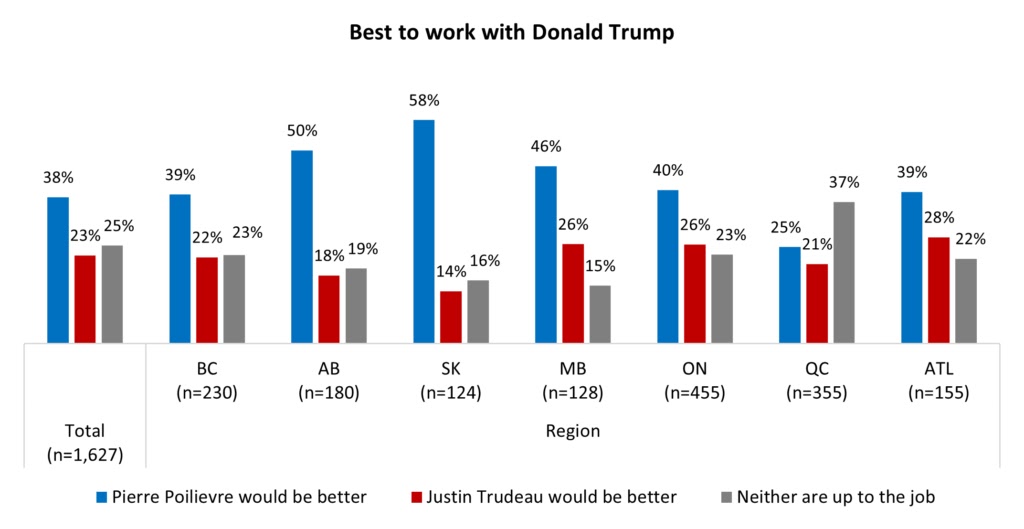
Two-in-five (38%) of Canadians polled say Poilievre is better suited to deal with a second Donald Trump presidency, while 23% say Trudeau would be, and 25% say neither are up to the job.

Canadians prefer Trudeau to deal with Harris, Poilievre to work with Trump | Angus Reid Institute (news release):

November 4, 2024 – Canadians will join their American neighbours in watching results pour in  tomorrow night for the U.S. election.... Regardless of who wins, the result will have a significant impact on Canada, as the United States remains this country’s closest ally and trading partner. Both Prime Minister Justin Trudeau and opposition leader Pierre Poilievre will make the case that they’re better suited to manage this relationship.... 

"Given the importance, economically, culturally and from a security standpoint, of the Canada-U.S. relationship, the Angus Reid Institute asked Canadians which of the two federal party leaders in Canada most likely to form government they feel is more suited to handle the relationship with each potential president....

"Trump had a rocky relationship with Trudeau during his first term. Though the two started on good terms, relations soured. Trump called the Canadian PM 'two-faced' after video surfaced of Trudeau and other world leaders reportedly joking about Trump. Since leaving office he has called Trudeau 'weak' and a 'far left lunatic'. The Liberal government has also made an effort to tie Poilievre to Trump and his divisive politics. Current polling suggests that correlation hasn’t borne much fruit....

"Canadians prefer Poilievre to have a go at the Trump relationship, rather than have Trudeau take it on a second time. Two-in-five (38%) say Poilievre is better suited, while 23 per cent say Trudeau would be. That said, one-quarter say neither (25%) are up to the job. Notably, Poilievre is the top choice in every province, other than in Quebec, where 'neither' wins:

"Poilievre receives more confidence among Liberal and NDP voters in this scenario but remains relatively uninspiring for these groups. The larger factor at play here is that every group is more likely to say that neither individual is up to the job with the unpredictable Trump at the helm....

"For detailed results by age, gender, region, education, and other demographics, click here. For full release including methodology, click here."

Read more: https://angusreid.org/harris-trump-trudeau-poilievre/

Thursday, November 14, 2024

Trust in medical profession plummets in USA

In the past four years in the United States, public opinion of doctors and hospitals has changed from majority trust to majority mistrust.

Trust in Doctors and Hospitals Plummets | Brownstone Institute | Josh Stevenson:   

September 5, 2024 - "A new paper in JAMA analyzes survey respondents in the US over the period of time right after the Covid pandemic started in April 2020 and through early 2024. It reveals a significant decline in trust in physicians and hospitals, dropping from 71.5% in April 2020, to 40.1% in January 2024. Lower trust levels were strongly associated with reduced likelihood of receiving Covid-19 vaccinations and boosters.... 

"One incredibly interesting part of this study was the revealing of the open-text responses that survey respondents gave for their lack of trust. From the supplement, here are the top 4 themes why patients have lost trust. 

  1. Financial Motives Over Patient Care: This theme includes perceptions of healthcare as primarily profit-driven, where financial incentives outweigh patient welfare. Respondents believe that decisions are made based on profitability rather than the best interests of patients.
  2. Poor Quality of Care and Negligence: Responses that mention experiences of neglect, inadequate care, misdiagnosis, or dismissive attitudes from healthcare providers fall under this category. This also includes perceptions of healthcare professionals not listening or taking patient concerns seriously. 
  3. Influence of External Entities and Agendas: Here, the focus is on the belief that decisions in healthcare are unduly influenced by pharmaceutical companies, government entities, or other external powers. This includes suspicions of dishonesty or withholding information for nonmedical reasons. 
  4. Discrimination and Bias: Responses indicating experiences or beliefs that healthcare providers exhibit bias, discrimination, or lack of cultural competency. This can include racial discrimination, gender bias, or insensitivity to patient backgrounds.

"Another interesting analysis in the supplement was the inclusion of political affiliation. The tendency for Republicans and Independents to have lower trust overall than Democrats should not surprise anyone, as the polarization of vaccines, masks, and lockdowns made it clear that the left was in favor of doing anything at all in the name of combating Covid, no matter the cost.

"As we witnessed firsthand in 2020 and 2021, and even today, the condescension, overt political motivations, and outright derision directed at those who were rationally skeptical of a brand-new vaccine, masks, and the extreme and harmful lockdown policies by medical practitioners and hospital systems have finally led to an inevitable consequence: the public simply does not trust them anymore. And not by a small margin — there has been a massive swing from majority trust to majority distrust. For anyone who was paying attention, this is not shocking....

"I hope that the practitioners we truly need to rely on when we require medical care see this as a wake-up call and understand just how much damage they have done to their long-term doctor-patient relationships. Now, instead of starting from a place of trust, they are starting from a deficit. This is not just bad for their careers; it’s bad for the patients."

Published under a Creative Commons Attribution 4.0 International License
For reprints, please set the canonical link back to the original Brownstone Institute Article and Author.

https://brownstone.org/articles/trust-in-doctors-and-hospitals-plummets/

Saturday, October 26, 2024

Free speech a top concern of U.S. voters

Free speech is a top concern of U.S. voters in 2024. But a majority of both Republicans and Democrats lack confidence in the other party to protect their free speech, while a majority of independents lack confidence in both those parties. 

POLL: Free speech a top concern for Americans in 2024, more important than crime, immigration, and health care | Foundation for Individual Rights and Expression (FIRE):

October 24, 2024 - "A new poll from the Foundation for Individual Rights and Expression finds that free speech is a critical issue for most Americans in the 2024 presidential election, topping other hot button issues like health care, immigration, crime, and guns.

"FIRE’s poll, conducted by NORC at the University of Chicago, asked 1,022 Americans how important a host of issues were in the context of the upcoming election. The top answer was inflation, with 68% saying increasing costs was 'very important' and 91% calling it at least 'somewhat important.' But the next top answer was free speech, with 63% calling it 'very important' and 90% saying it was at least 'somewhat important'....

"Americans from both parties view free speech as a significant issue, with 91% of Republicans and 90% of Democrats agreeing it’s at least 'somewhat important'.... Republicans were more likely to rate it 'very important” (70% vs. 60%), and they were more likely to respond that they were somewhat concerned about their ability to speak freely in the U.S. today (63% vs. 42%). Republicans were also more likely o respond that they speak less freely today than four years ago (46% vs. 21%).

"Assessments of the two major political parties’ free speech bonafides were mixed, but slightly positive. A majority of Americans also expressed confidence that Republicans (51%) and Democrats (56%) will protect their free speech rights in office. A little under half (45%) said Democrats support free speech either a 'great deal' or 'quite a lot' while 28% answered 'very little' or 'not at all,' compared to 42% and 31% respectively for Republicans. 

"But Americans’ assessment of the two major parties were sharply polarized by their political affiliation: 77% of Democrats say they believe the Democrats support free speech 'a great deal' or 'quite a lot,' and 91% are at least 'somewhat' confident they would protect their free speech rights. 75% of Republicans say they believe the Republicans support free speech 'a great deal' or 'quite a lot,' and 85% express high confidence they would protect their free speech rights. 

"But 53% of Republicans think Democrats support free speech 'very little,' or 'not at all,' and 50% of Democrats say the same of Republicans. 77% of Republicans and 72% of Democrats also reported they are either “not too” or “not at all” confident the opposing party will protect their free speech.

"Self-described Independents gave low marks to both parties in roughly equal measure. A supermajority reported low or no confidence that Democrats (62%) and Republicans (61%) would protect their free speech. Only 23% said Democrats support free speech 'a great deal' or 'quite a lot,' and only 28% said the same of Republicans....

"The FIRE/NORC survey was conducted October 11-14, 2024, using NORC’s AmeriSpeak® probability-based panel, and sampled 1,022 Americans. The overall margin of error for the survey is +/- 4.18%.

"The Foundation for Individual Rights and Expression (FIRE) is a nonpartisan, nonprofit organization dedicated to defending and sustaining the individual rights of all Americans to free speech and free thought — the most essential qualities of liberty. FIRE educates Americans about the importance of these inalienable rights, promotes a culture of respect for these rights, and provides the means to preserve them."

Read more: https://www.thefire.org/news/poll-free-speech-top-concern-americans-2024-more-important-crime-immigration-and-health-care

Thursday, October 10, 2024

Majority opposes Trudeau's EV mandate

An Ipsos survey finds that a majority of Canadians oppose the Trudeau government's plan to ban the sale of new non-electric vehicles,  while two-thirds say that its 2035 deadline is unrealistic. 

Poll finds most Canadians oppose feds’ plan to ban conventional vehicle sales | Western Standard | Jonathan Bradley:

October 5, 2024 - "More than half of Canadians are against the federal government’s proposal to force all new vehicles sold in Canada be electric by 2035, according to a poll conducted by Ipsos on behalf of the Montreal Economic Institute (MEI).... Ipsos found 55% of Canadians disagree with the federal government’s decision to ban the sale of conventional vehicles by 2035. In every region surveyed, it said a larger number of respondents were against the ban than in favour of it.

"Among Canadians who do not own an EV, fewer than one-quarter said their next vehicle would be electric. Key reasons cited for this lukewarm attitude included the high cost of EVs (70%), the lack of charging infrastructure (66%), and their reduced performance in Canada’s cold climate (64%). 

"Across Canada, Ipsos said 26% of Canadians believe the federal government’s plan to ban the sale of conventional vehicles is realistic. Meanwhile, it said two-thirds maintain the plan is unrealistic....

"It [also] found Canadians were troubled by the effects federal legislation has caused in stalling or cancelling energy projects. Additionally, it said seven-tenths were concerned by the negative impact on Canadian jobs arising from the cancellation of tens of billions of dollars in energy projects due to regulatory hurdles. Seventy-six percent said the Canadian government’s environmental impact assessment process takes too long. Nine percent had the opposite view."

Read more: https://www.westernstandard.news/business/poll-finds-most-canadians-oppose-feds-plan-to-ban-conventional-vehicle-sales/58399


Trudeau's EV mandate will break the bank | Western Standard | Kris Sims:

August 1, 2024 = "Trudeau’s forced EV mandate will cost a shocking amount of money for taxpayers, and Canada doesn’t have the juice to power these electric vehicles. And, this plan is a non-starter for two key reasons:

"First, let’s look at the costs. Various levels of government have pledged about $57 billion to car companies that are pledging to make EVs, including billions for Volkswagen and Honda. That’s the corporate welfare cost, with governments pouring taxpayers’ money onto the boardroom tables in Berlin and Tokyo.

"Then there’s the sticker price on the EVs in the lots.... The cheapest new electric car in Canada sells for about $41,000, with a vehicle like a Nissan Leaf eligible for a $5,000 rebate from the feds. Last year, Canadians bought about 1.7 million new vehicles.... If those vehicles were all EVs, the cost of the rebates would be about $8 billion. With the cheapest new gasoline-powered sedan selling for about $21,000, and with no rebate costs to taxpayers, there’s a big price difference for both the person buying the car and taxpayers.

"What about power bills? The average Canadian home uses about 10,861 kWh in electricity per year. The average electric car uses about 4,310 kWh of energy per year, according to EVBox, a company that produces electric vehicle chargers. The average family’s electricity use would jump by about 40 per cent if they had one EV and charged it at home. 

"Where is the electricity for these EVs coming from? Calculations done in British Columbia show if everyone switched to an electric car in B.C., the province would need about nine new Site C Dams.... Creating nine new Site C Dams tomorrow would cost about $144 billion.... Alberta is home to about three million vehicles, and if they were all electric, that ... province would require about three nuclear plants to charge those vehicles. Who’s paying that tab? Taxpayers? Folks opening their power bills?... Today, record numbers of working families across Canada are visiting food banks and about half of Canadians are within $200 every month of not being able to make the minimum payments on their bills. They can’t afford higher power bills."

Read more: https://www.westernstandard.news/opinion/sims-trudeaus-ev-mandate-will-break-the-bank/56537

Monday, April 15, 2024

Canada's Conservatives open 20-point lead

The latest Abacus poll, conducted after the carbon tax increase on April 1, shows Canada's Conservative Party has opened up a 20-point lead over the governing Liberals. 

New survey says Conservatives open up big lead over Liberals since carbon tax increase | Westerm Standard | Shaun Polczer

April 12, 2024 - "[T]he CPC [Conservative Party of Canada] has opened its biggest lead yet over the Trudeau government. If an election were held today, the Pierre Poilievre-led party would gather 44% of the vote compared to 24% for the Liberals. That’s up three points from March 31, while the Liberal tally is up one.... 

"The NDP, at 17% is down 2% while the Bloc Québécois at 6% — 29% in Quebec — is down one point. At 5%, the Green Party gained a single point while the People’s Party lost a point to settle at 3%.

"According to Abacus Data, all of the interviews were done following the increase in the federal carbon tax on April 1 and in the midst of several pre-budget announcements by Trudeau and his various cabinet cohorts. 'Controlling for the independent effect of each of these is difficult but the before/after nature at least allows us to understand what has happened,'said Abacus Data CEO & Founder David Coletto. 'This 20-point lead is the largest we have ever measured for the Conservatives'.... 

"Conservatives are ahead everywhere except Quebec, where they are now statistically tied with the Liberals and BQ. Regionally, the Conservatives are well ahead in the Prairies, lead by 25 in BC and 19 in Ontario. In Atlantic Canada, the Conservatives are 18 points ahead of the Liberals....

Courtesy Abacus Data.

"Abacus said the carbon tax increase on April 1 has not yet had any noticeable impact on Liberal support, but may have helped the Conservatives. \We will need a few more weeks of data to know this for sure. This means that political harm of the carbon tax may have run its course and things can't get too much worse for the Liberals.'”

Read more: https://www.westernstandard.news/canadian/new-survey-says-conservatives-open-up-big-lead-over-liberals-since-carbon-tax-increase/53785

Read poll: https://abacusdata.ca/conservative-open-up-largest-lead-yet/ 

Friday, March 22, 2024

Canada last in international health care survey

In a 2023 survey of patients in 10 wealthy countries, Canada ranked last in access to primary health care. 

Canada ranks last in primary health care access among 10 wealthy countries: report | CP 24 | Canadian Press:

March 21, 2024 - "Canada ranked last in access to primary health care in a survey of 10 high-income countries released by the Canadian Institute for Health Information on Thursday. Eighty-six per cent of Canadians aged 18 and older said they had a doctor or a place they usually go for medical care in the 2023 survey by the Commonwealth Fund. That's down from 93 per cent of those surveyed in 2016 - and means that an estimated four million Canadian adults did not have access to primary care last year, the study said.

"The percentage of people who had access to primary care was lower than in ... Australia, France, Germany, the Netherlands, New Zealand, Sweden, Switzerland, the United Kingdom and the United States. The average among all 10 countries was 93 per cent.... The United States performed only slightly better than Canada, with 87 per cent of American adults saying they had primary care access.

"Canada also ranked last in ability to get a same or next-day appointment to see a doctor or nurse. Only 26 per cent of Canadian adults were able to get medical attention that quickly, down from 46 per cent in 2016. 

"The survey also ... found that 39 per cent of Canadians without primary care had at least one chronic health condition and 29 per cent were taking one or more prescription medications.

"The 2023 Commonwealth Fund [study] also surveyed participants about their mental health. It found the COVID-19 pandemic, together with economic stressors, was taking a toll on Canadians, with 29 per cent of adults reporting depression, anxiety or another mental health condition in 2023.

"The Commonwealth Fund is a U.S.-based non-profit foundation that funds surveys of patients and health-care providers in multiple countries.... Researchers conducted interviews between March and August 2023. In Canada, 4,820 people were interviewed."

Read more: https://www.cp24.com/lifestyle/canada-ranks-last-in-primary-health-care-access-among-10-wealthy-countries-report-1.6817488

Commonwealth Fund survey results: https://www.cihi.ca/sites/default/files/document/how-canada-compares-cmwf-survey-2023-meth-notes-en.pdf

Canada lags behind in terms of access to health care | CP24 | March 21, 2024:

Sunday, February 18, 2024

How "woke" is Canada?

"Surprisingly, despite their reputation," says Prof. Eric Kaufmann, "Canadians largely reject the woke ideology." 

Canadians aren’t actually ‘woke’ | The Hub ] Eric Kaufmann: 

February 15, 2024 - "'Woke' refers to the sacralization of historically marginalized race, gender, and sexual identity groups. This belief system elevates equal outcomes and emotional harm protection for such groups as its highest value.... Prime Minister Justin Trudeau has distinguished himself on the world stage as the paragon of this belief system, and many outside Canada assume he reflects an equally woke Canadian public. But is this truly the case? To better understand Canadian views, The Macdonald-Laurier Institute asked Maru Public Opinion Polls to conduct a nationally representative survey of 1,500 adults, in which I fielded numerous questions previously put to American and British samples.... 

"Surprisingly, despite their reputation, Canadians largely reject the woke ideology. For instance, they oppose the idea of separating pupils in class by race—assigning whites as privileged and minorities as oppressed—by a whopping 92 to 8. By 85-15, they reject the idea of teaching children that 'There is no such thing as biological sex, only gender preference.' Excluding those with no opinion, 80 percent of respondents were against the idea of J.K. Rowling being dropped by her publisher. By a similar slant, Canadians say 'political correctness has gone too far.'

"In most cases, respondents came out strongly against established practices found in Canadian institutions. For example, when Toronto teacher Richard Bilkszto pushed back against diversity trainer Kike Ojo-Thompson’s characterization of Canada as more racist than the United States, none of his colleagues defended him and his travails eventually drove him to suicide. Yet, by a stunning 95-5 margin, Canadians overwhelmingly reject the idea that their country is more racist than other countries. Among those with an opinion, just 30 percent say that Canada is a racist country while 70 percent disagree. A similar share says they do not want schoolchildren taught that the country is racist.

"Or consider the fact that almost all statues of Sir John A. Macdonald have been removed from major Canadian cities. Yet, Canadians oppose removing statues of Canada’s Father of Confederation by a two-to-one ratio. Among those with an opinion, a mere 8 percent say activists should be allowed to remove statues without government approval, with 92 percent against. Almost 45 percent of Tory and PPC voters strongly disagree with removing Macdonald. In addition, only 5 percent of Liberal, NDP, and Green voters strongly agree that his statues should be removed. The majority of left-wing voters oppose rather than support Macdonald’s removal.

"Canada has been one of the most trans-affirming societies on earth. Only in the past year have conservative premiers in New Brunswick, Saskatchewan, and Alberta begun to curb trans activism in education....  But when we look at public opinion on the trans question, an entirely different picture emerges. By a four-to-one ratio, Canadians oppose gender reassignment surgery for those under 16. By two-to-one, they want parents informed of pronoun changes at school and don’t want transgender women (i.e. biological males) to enter women’s sports competitions. Three in four Canadians say we talk too much about transgenderism. Even when it comes to people displaying their pronouns in work emails or social media profiles, more Canadians disapprove of this practice than support it....

"It is striking how similar Canadian public opinion is to that of supposedly more conservative America or Britain. Across 30 questions I asked in Britain in 2022 and Canada in 2023, the average difference in opinion between the two countries is just 0.3 of a percentage point. Furthermore, of the 13 questions asked in the U.S. in 2021, the average gap with this Canadian survey was just one point! There is essentially no appreciable difference.... French-English differences are also much smaller than the stereotype of woke English Canada versus plain-speaking traditional French Canada would lead us to expect. Francophones are somewhat less woke than Anglos on many transgender questions and more inclined to colourblindness rather than race and gender-conscious Diversity, Equity, and Inclusion (DEI) policies. However, Anglophones are more critical of Black Lives Matter than Francophones, more likely to say political correctness has gone too far, and more opposed to removing statues and renaming buildings.... 

"English Canada’s culturally-left political and media elite contrasts with that of red-state America, and, to a lesser degree, with Britain and Quebec. If English-Canadian public opinion is largely aligned with the others, why have its policies and politicians diverged from their British, American, and Quebecois equivalents? One possible answer is Canadians’ relatively high trust in elites and institutions. More than half of Canadians trust journalists while fewer than 20 percent of Britons and barely a third of Americans do. Even 30 percent of conservative Canadians trust journalists compared to 11-15 percent of conservative Americans and Britons. A somewhat similar pattern holds with respect to academics and teachers. Canadians’ elevated trust in their largely progressive-dominated institutions gives the Canadian elite more leeway to deviate from public opinion.

"The key takeaway is that culture war issues are far less settled than a lot of mainstream commentary would have Canadians believe. Polling irrefutably shows that Canadians are as inclined as Americans or Britons to disagree with a lot of the woke shibboleths that are present in the media, universities, and other major institutions. As for the political implications, these findings may represent a glaring opportunity for conservatives and a glaring risk for progressives."

Read more: https://thehub.ca/2024-02-15/eric-kaufmann-canadians-are-not-actually-woke/

Read report: https://macdonaldlaurier.ca/politics-of-culture-wars-canada/

The True Definition of Wokeness? - Eric Kaufmann | The Equiano Project |  September 8, 2023:

Sunday, April 23, 2023

Canadians want to keep working from home

It's not just the federal government employees; more than a third of Canadians working from home do not want to return to the job site.

Canadian employers facing battle to bring workers back into the office } Western Standard - Shay Bottomley:

April 22, 2023 - "Canadian employers continue to face an uphill battle to get employees back into the office, according to a new study by the Angus Reid Institute. The research from the non-profit institute comes after the federal government recently announced a mandatory return to the office for all public servants.

"Among those who currently work from home at least some of the time, which comprises three-quarters of those surveyed, 36% said they’d return to the office full-time with no issues if they were asked to do so. However, a similar proportion (31%) said they would return, but consider switching jobs, with 21% likely to hand their notice in should they be ordered back into the office.

"Remote working may have initially been seen as a temporary measure at the beginning of the pandemic, but millions remain working from home, at least temporarily, three years on.

"Only half [of] those who work from home said they enjoy either good or great connections to their colleagues, compared to 84% of on-site employees. Nevertheless, 81% of remote workers provided a positive response when questioned on their work-life balance, compared to just 54% of those who work on location. Importantly, neither work arrangement appears to be more advantageous in terms of productivity, with nearly the same proportion of on-site workers (77%) saying they are as productive as remote workers (81%).

"The data will not make decisions easy for employers whether to order their staff back into the office in Canada’s employee-favoured labour market.

"The Angus Reid Institute conducted an online survey from Feb. 9-12, 2023 among a representative randomized sample of 1,622 Canadian adults who are members of Angus Reid Forum. For comparison purposes only, a probability sample of this size would carry a margin of error of +/- two percentage points, 19 times out of 20. Discrepancies in or between totals are due to rounding."

Read more: https://www.westernstandard.news/alberta/canadian-employers-facing-battle-to-bring-workers-back-into-the-office/article_5762e170-dd4a-11ed-89a0-2f8b0178b67c.html

"Companies forcing return to office a dealbreaker for some, survey suggests," CBC News, March 23, 2022:

Wednesday, February 8, 2023

67% say everything feels broken in Canada: poll

67% of respondents told a Postmedia/Leger poll that everything feels broken in Canada right now; and 50% of respondents say they're angry about it.

Most Canadians agree 'Canada is broken' — and they're angry about it: National poll | National Post - Adrian Humphreys:

February 6, 2023 - "A majority of Canadians looking at the country they see around them say everything seems to be broken. Concerned about rising costs, the state of health care, affordable housing, jobs and more, half of us are also angry about the way Canada is being run, a national opinion poll says. But before settling on the easy image of old, malcontent men skewing the survey, consider this: A higher percentage of women agreed Canada is broken than did men, and more in the youngest age brackets than among the oldest.

"Nor is it just Albertans, famous for their distrust of Ottawa, or Quebecers, where public opinion often deviates from the rest of Canada. Yes, the sentiment is higher in Western Canada than in the East, but a solid majority of respondents in every measured region agreed that everything feels broken right now, according to the Postmedia-Leger national poll. Two-thirds of those asked (67 per cent) agreed everything feels broken — almost half of those even strongly agreed — while 25 per cent disagreed, only seven per cent strongly....

"'I didn’t think it would be that high. I thought maybe it was more a noisy minority as opposed to a prevailing majority opinion,' said Andrew Enns, an executive vice-president at the market research company Leger, and lead researcher for this data.... Enns said his team heard talk for months about systems seeming to be falling apart or broken.... With the concept becoming a hot button issue, it seemed time to see what Canadians think about it, Enns said. Leger gauged attitudes of adult Canadian residents on their satisfaction with how the country is running....

"Asked to describe how they’re feeling when they think of how Canada is being managed, half of all respondents said they felt 'angry.' That includes 30 per cent who said they’re 'somewhat angry,' but also 20 per cent who specified they were 'very angry'.... There are some people content with things, but it’s a minority — 41 per cent of respondents said they were “happy,” but precious few said 'very happy,' only four per cent. The remaining nine per cent said they didn’t know....

"More women said they were angry than men (51 per cent compared to 48 per cent). Of those who said they were happy, more were men (44 per cent compared to 39 per cent). The same held for everything feeling broken: 70 per cent of women agreed compared to 64 per cent of men; 32 per cent of those women felt it strongly, while 27 per cent of the men did.... It’s the intensity of anger where men are tops. Angry men tend to be angrier than angry women: 17 per cent of angry women said they were very angry, while 22 per cent of angry men took it up a notch.... 

"Respondents in Alberta were the least likely to say they were happy — just 29 per cent. Respondents in B.C. were the happiest, at 46 per cent, followed by Quebec at 44 per cent, Ontario at 42 per cent, which is the same as the Atlantic provinces (which are measured together), followed by Manitoba and Saskatchewan (measured together) at 40 per cent. Sixty-one per cent of Alberta respondents chose angry, with almost half of them dialling it up to very angry. That 30 per cent of very angry Albertans far exceeded respondents in other regions: 17 per cent in both Quebec and Atlantic Canada; 19 per cent in Ontario and B.C., 22 per cent in Manitoba and Saskatchewan....

"Respondents were asked to choose the issues that have the most impact on them and their family: Rising costs and inflation topped the list, named by 68 per cent of respondents. Next came health care, named by 59 per cent. The other issues, in descending order, were: Affording a place to live (43 per cent), jobs and the economy (40 per cent), environment and climate change (35 per cent), crime (30 per cent), homelessness (29 per cent), schools and education (24 per cent), COVID-19 (21 per cent), labour shortages (20 per cent), affording post-secondary education (15 per cent), immigration/passport system (15 per cent), state of local roads (14 per cent), substance use (14 per cent), Canada’s response to the war in Ukraine (14 per cent), public transportation (12 per cent), airport/travel delays (12 per cent), state of highways (11 per cent)....

"The public opinion poll studied responses from 1,554 adult Canadian residents through online surveys, randomly recruited through Leger’s online panel from Jan. 20 to Jan. 22. Results were weighted according to age, gender, and region, as well as by education and presence of children in the household in order to ensure a representative sample of the population. As an online survey, traditional margins of error do not apply, according to Leger. If the data had been collected through the same-size probability sample, the margin of error would be reported as plus or minus 2.5 per cent, 19 times out of 20."

Read more: https://nationalpost.com/news/politics/canada-is-broken-poll

Thursday, July 21, 2022

Support for vax passes & mask mandates waning

by George J. Dance

According to scientists, vaccine efficacy against Covid 19 infection has waned. And so has Canadians' tolerance of Covid vaccine passports and other restrictions, according to a national polling firm. The Angus Reid Institute reported on July 20 that, while "many Canadians continue to be worried about the risk the virus poses to their own and their families’ health," and "while some are taking their own steps to prevent further spread, the appetite for government public health measures is minimal – and a fraction of what it was in previous waves."

"Last September, amid the fourth wave of the pandemic," Angus Reid reminds us, "seven-in-ten Canadians (70%) said they would support a vaccine passport in their community to require residents to show proof of inoculation to enter larger public spaces." That was the month that Prime Minister Justin Trudeau won re-election campaigning to bring vax passes in. Health matters, including vaccine passes, constitutionally are not the federal government's business; but Trudeau promised to give provincial governments a billion dollars to mandate them.  

By 2022, Canadians' support of Covid restrictions had dropped - a January Angus Reid poll found a majority in favor of "lifting restrictions" in general. However, vaccine passes remained popular. As late as mid-March, the pollster was reporting that 64 per cent - almost two Canadians in three - "supported proof of vaccination at places like restaurants and theatres in their community."

And today, now that we face a reported seventh wave of Covid? According to the latest Angus Reid survey, conducted July 13-17, the vaccine pass "concept is now supported by one-in-four (25%)." Vaccine passes no longer enjoy majority support in any region or among any demographic group.  

Public support for mask mandates has taken a similar tumble. The March Angus Reid survey found that "nationally, 73 per cent supported continuing masking requirements in public spaces" - almost three Canadians in four. By mid-July, that support has fallen to a bare majority; just "half say they would support mandating [masks] in public spaces (51%)."   

Enthusiasm for renewed mask mandates remains strongest in Atlantic Canada (at 62%), Ontario (55%), and British Columbia (also 55%). It is lowest in Alberta (36%) and Saskatchewan (38%). Support has fallen most among men under 55, of which "Just one-in-three would implement a mask mandate in their community compared to a majority of all other age and gender combinations."  

Canadians have not given up on facemasks; or have they?   Almost three-quarters (74%) of those polled say that masks are effective "at reducing the spread of COVID-19." Yet just 30% report "wearing a mask when they are inside places like grocery stores, banks or movie theatres 'most' or 'all of the time'." More than half (53%) say that they "rarely" or "never" wear one.

Only 14% of respondents want travel restrictions reinstated. Almost three times as many, 38%  – roughly two in five – told Angus Reid that no government action is needed in the event of a seventh wave of Covid.

The Institute surveyed a representative randomized sample of 1,602 Canadian adults who are members of the Angus Reid Forum. For comparison purposes only, a probability sample of this size would carry a margin of error of +/- 2 percentage points, 19 times out of 20. 

Sources:

"Canadians still hesitant to withdraw proof of vaccination measures, masking in indoor spaces," Angus Reid Institute, March 15, 2022.  https://angusreid.org/covid-restrictions-precautions-masking-trudeau/

"Canadians’ desire to implement mask mandates or vaccine passports plunges, Angus Reid Institute, July 20, 2022.  https://www.angusreid.com/intelligence/canadians-desire-to-implement-mask-mandates-or-vaccine-passports-plunges/

"As COVID BA.5 cases surge, Canadians’ desire to implement mask mandates or vaccine passports plunges," Angus Reid Institute, July 20, 2022. 
https://angusreid.org/wp-content/uploads/2022/07/2022.07.20_COVID_Restrictions.pdf

Saturday, June 18, 2022

Canadians' trust in media falls to new low


June 15, 2022 - "Canadians’ trust in the legacy media has reached a new low, according to a report from the Reuters Institute and the University of Oxford. The loss in media trust shown by the 2022 Digital News Report was mainly among anglophone Canadians, with francophones having higher trust levels in legacy outlets. Only 39% of anglophone Canadians said they 'trust most news,' a 16% drop from 2016. Meanwhile, 47% of francophones 'trust most news,' an 8% drop from 2016. The combined rating of Canadians trusting 'most news' equates to 42%, a 13% drop since 2016.

"The report also suggests fewer Canadians are using many major legacy media outlets’ online platforms. Compared to 2016, 5% less of anglophones use CBC’s online platform and 3% less use CTV News’. The study also found fewer Canadians were using Global, Buzzfeed and CNN’s online news platforms. CBC News, the Toronto Star and CP24 are the anglophone Canadian outlets with the highest amounts of distrust. Canadians also considerably distrust American media outlets including CNN, The New York Times and Fox News.

"According to the report, less Canadians also believe that the legacy media is independent and free of political or business influence. Only 27% percent of anglophone Canadians believe the media is not politically influenced, down 17% from 2016. The figure held up at 38% for francophones, making for a combined trust rating of 29%.

"The study also found that trust in the legacy media is lower among younger people, with those under 35 showing greater scepticism. Further, the study found viewers are avoiding legacy media outlets altogether. According to the study, 71% of people are avoiding the legacy media, a 16% increase from 2017. Many respondents cited the legacy media’s Covid-19 and political coverage as well as negative impacts on mental and physical health as reasons for tuning out of the media....

"The Digital News Report 2022 was conducted while the Freedom Convoy demonstrations were taking place in Ottawa. Many observers accused the legacy media of having a bias against the convoy, after many claims made by the legacy media about the movement were proven to be wrong. The CBC, for example, had to retract two stories related to the convoy.

"Despite fewer Canadians tuning into legacy media outlets, the Trudeau government has committed millions to bail out media outlets and increased funding to the CBC – another possible factor in the loss of legacy media trust.

"A survey by the public relations firm Edelman had also found a loss Canadians’ trust in the legacy media, with 61% of respondents saying they believed journalists are 'purposely trying to mislead people by saying things they know are false or gross exaggerations,' which was up 12% from the previous year."

Saturday, February 26, 2022

Majority of Canadians 18-54 approved of Freedom Convoy

One Canadian pollster found that a "small fringe majority" of Canadians aged 18-54 sympathized with the Freedom Convoy, while the overwhelming majority of their elders opposed it.   

Trudeau’s convoy response gets failing grade, but even fewer support protesters: Ipsos poll | Global News - Aya Al-Hakim:

February 24, 2022 - "As the so-called “Freedom Convoy” comes to an end in Ottawa, Canadians remain divided on how they feel about the protests. According to a new Ipsos poll published Thursday, Canadians’ approval of Justin Trudeau’s handling of the convoy blockade was only seven points higher than that of the protesters. 

"The poll conducted exclusively for Global News showed that 43 per cent of Canadians approved of the way Trudeau handled the three-week long protests in Ottawa while 36 per cent per cent supported the way the truckers handled themselves throughout the occupation. In Ontario ... 49 per cent approved of Doug Ford’s handling of the situation, narrowly beating the 46 per cent who approved of Trudeau’s performance.

"'What’s particularly worrying is that 52 per cent of the people that we interviewed said that the prime minister’s divisive rhetoric and the way that he approached the protest was mostly responsible for what happened,' Darrell Bricker, CEO of Ipsos public affairs, told Global News. Bricker explained that Trudeau characterized people who were part of the protest as the ones who voted for the opposition parties, particularly the People’s Party and the Conservative Party, but 'the data shows that people aren’t particularly united around any sort of partisan choice.' 

"'This is really a group of the population…who really are feeling left out, left behind and very concerned about the way that the government is not only managing the pandemic, but also the way that the economy is going right now,' said Bricker. 'They have a very challenged sense of hope. But it’s not defined in partisan terms. The prime minister chose to define it in those terms, and the reaction from the public to that has been quite negative. As we’ve seen in the polling results, 52 per cent of the population said he added fuel to the fire,' he added.

"According to the poll, nearly 46 per cent say that while they may not agree with everything that the convoy participants have said and done in Ottawa, their frustration is legitimate and worthy of people’s sympathy. 'So as bad as things got during the course of the protest, it really didn’t affect how people felt about the protesters themselves,' Bricker said.

"About 48 per cent of people also said that the protest probably wouldn’t have taken place if people weren’t feeling the level of economic frustration that they’re feeling. On top of that, 54 per cent of Canadians also believe the protests in Ottawa at least partially contributed to the loosening of COVID-19 restrictions in the country.

"Bricker said the issue here is that 'even though authorities may not like it,' data is showing that protesters have gained a certain amount of sympathy among the Canadian population.

"The poll also states that 'a deep generational divide is evident,' with a majority of those aged 18-34 (58 per cent) and 35-54 (53 per cent) sympathizing with the protesters compared to only 32 per cent of those aged over 55. Bricker said that younger Canadians are feeling very insecure in this economy and are sympathizing more with the frustration that the convoy is presenting compared to older Canadians and those who are more economically secure. 'Usually, we see things through a partisan lens or we see them through a regional lens. Not this time. It’s a different type of division that we’re seeing,' he said.

Read more: https://globalnews.ca/news/8640772/ipsos-poll-trudeau-convoy-response/

Saturday, February 12, 2022

The Power of Protest

The Power of Protest | Brownstone Institute - Jeffrey A. Tucker:

February 3, 2022 - "Israel has repealed [Covid] restrictions and is backing off vaccine mandates, even as cases and deaths are hitting new highs, and implausibly so in the most vaccinated and boosted country in the world. The UK has backed off too. Same in Denmark, Ireland, Finland, and Norway. Switzerland has joined in, and Sweden has rolled back its plans for an extended vaccine passport [and] has decided to get rid of them completely. Saskatchewan is ending all restrictions. We are seeing local governments and universities in the US gradually stepping back. No new cities have joined the brigade for vaccine passports and Denver, CO, is stopping theirs....

"Monmouth University tracks attitudes in the US toward government and media as it pertains to the pandemic response. At this point, every arrow over time slants down to the right. The number of people opposing vaccine passports outnumbers those supporting them by 10 points. A polled 70% say it is time we accept Covid as normal....

"It is surely not a coincidence that all of this accelerated the same week as the trucker convoy formed in Vancouver and made the trek across ... Canada ... in the snow, ending up in Ottawa and gathering many tens of thousands of citizens to protest. The Prime Minister fled the city and went to his bunker, making what looked like hostage videos that denounced the truckers with all the usual epithets. 

Crowds cheered Freedom Convoy Canada, January 27, 2022. Photo by Rise of the Dots! CC BY, Wikimedia Commons

"What’s even more striking is that the media in the US and Europe did not cover the convoy, probably the largest in history and certainly the most important protest in modern times in Canada. The topic never ended up on the front page of either the New York Times or the Wall Street Journal. And yet: the effect was hugely powerful. Public opinion in Canada swung 15% to create a solid majority against all restrictions and mandates.... And other governments around the world are paying attention.... They are backing down, more already in Europe than the US. But even in US blue states, you can see evidence that the basis for restrictions and mandates is falling apart. Let’s also mention New Zealand, the island nation that pretended it would somehow magically make the virus go away. Now with wave after wave of cases, even the crazy Jacinda Ardern is rolling back quarantine mandates and gradually reopening the country. 

"The great slogan is 'living with Covid.' It is an implicit repudiation of everything that has happened for two years. It’s what we should have done all along. But the fanatics took over. The hysterical scream back in 2020 was that the power of the state, backed by media and corporate interests, would somehow make the virus go away. It was always ridiculously unachievable. The attempt unleashed massive abuse against the population, disrupted economies everywhere, and unleashed a tremendous amount of financial corruption that is still going on today. 

"We are nowhere near done with this. Massive restrictions are still in place. Travel is still a disaster. The mask mandate on transportation is as awful as ever. The segregation in DC, NYC, and Boston is morally repulsive. Plus, so many lives have been shattered. So many businesses have closed. Public health is in shambles. The demographic disruption has been profound. There are scandals lurking everywhere. What exactly were Fauci, Farrar, and Collins doing the whole of February 2020 instead of examining ways that sick people could get well? Why did they use burner phones? And that article debunking the lab leak in Nature, the one highly criticized later. How did that come about?

"Mysteries abound about the vaccine trials. And wait until people have a look at the “Emergency Use Approval” documents submitted by the manufacturers. They will discover that the pharma companies never promised much at all. They certainly never said that the vaxx would stop the spread, keep people from being infected, much less end the pandemic. They never said that it would work against variants.... 

"Governments spent many trillions of dollars, most of which ended up in the pockets of well-connected elites in the corporate and banking sectors. The payoffs and graft connected with everything, from testing kits, to masks, to therapeutics will be alarming to behold. And wait until people figure out that all along we might have had solid generics that have a massive effective impact on early treatment. 

"All wars come to an end, but governments rarely think in advance about the exit strategy. Instead, they kill and destroy until exhaustion sets in and then try to sneak away hoping that everyone will just move on. That’s pretty much how things fared with the Iraq War, and the results were devastating for the whole world. There are analogies to how governments are sneaking away from the catastrophe of the last two years. It’s been a war on people, a war on reality, and an attack on rights and liberties on a scale and scope that is without precedent in the modern age. None of it worked. Indeed, that is incredibly obvious now, and wholly humiliating and discrediting for vast swaths of the ruling class. 

"What kind of world emerges on the other side? There will be hatred against experts, elites, governments, media, pharmaceuticals, politicians, and deep-state bureaucrats. It’s already happening. And think of this: if it can happen in Canada, it can happen anywhere. Who would have imagined that it would be Canadian truckers who would step up and save the world?

"It’s a lesson to all of us. It shows that only an active minority of people can make a massive difference, if they speak with moral conviction and courage. Everyone else follows, provided the message is clear and speaks to the reality all around us.

"That, in a nutshell, is the case against despair. There is tremendous virtue right now in staying patient and letting the chips fall exactly where they have begun to fall. Yes, resignations would be ideal but regardless there will be a political realignment and a cultural rethinking. Freedom can win in the long run. And the world will be rebuilt, on a much more solid foundation than was present two years ago. We tried an experiment in tyranny. It flopped. Despite the enormous cost of what took place, we will all find ourselves in a good position to see a rebirth of liberty, human rights, and prosperity on the other side."

Read more: https://brownstone.org/articles/the-power-of-protest/


This work is licensed under a Creative Commons Attribution 4.0 International License.

Tuesday, February 1, 2022

Majority want Covid restrictions ended in Canada

Majority of Canadians want COVID restrictions lifted: Poll | Toronto Sun - Brian Lilley:

January 31, 2022 -" A majority of Canadians now say it is time to end COVID restrictions, according to an Angus Reid poll, a sharp increase from when the same question was asked in early January.... The latest poll, taken Jan. 27-28, found 54% want restrictions to be lifted.... The poll asked people if they agreed or disagreed with the statement: 'It’s time to end restrictions and let people self-isolate if they’re at risk'.... 

"A majority back lifting restrictions ... with rural dwellers being more likely than urban dwellers to want restrictions lifted – 58% to 54%. Support for lifting is also the majority viewpoint for both men and women and across all but one age group.... Support for lifting restrictions is highest among men aged 35-54 at 67%, followed by men 18-34 at 60% and women aged 35-54 at 58%. Among women aged 55 and over, 51% disagree with lifting restrictions while 40% agreed."

Read more: https://torontosun.com/news/national/majority-of-canadians-want-covid-restrictions-lifted-poll

Incidence of Omicron: One-in-five Canadians report COVID-19 infection in their household since Dec. 1 | Angus Reid Institute (news release): 

January 31, 2022 – "With Omicron now appearing to have peaked, many Canadians are leaning toward reducing restrictions related to COVID-19 control in Canada. A majority (54%) now say it is time to remove restrictions and let Canadians manage their own level of risk, an increase of 15 percentage points since this question was asked in early January....

"These sentiments are subject to some considerable division across the country. At least 34 per cent in every region disagree with this idea, but a majority in every region other than Atlantic Canada feel the time is now to open things up:

"The lone majority-dissenting age and gender group on this question [is] women over the age of 54. At least half of other cohorts – led by 35- to 54-year-old men – say restrictions should end:

"The Angus Reid Institute conducted an online survey from Jan. 27-28, 2022 among a representative randomized sample of 1,688 Canadian adults who are members of Angus Reid Forum. For comparison purposes only, a probability sample of this size would carry a margin of error of +/- 2.5 percentage points, 19 times out of 20. Discrepancies in or between totals are due to rounding."

Read more: https://angusreid.org/omicron-incidence-restrictions/

Sunday, January 2, 2022

UK poll finds majority against another lockdown

Poll finds public do not want another lockdown | Order Order - Guido Fawkes:

December 17, 2020: Guido can’t remember the last time a poll on Covid saw the public really reject any proposed restrictions on civil liberties, however a new [poll] in today’s Times demonstrates just that. 

"According to a poll of 1,714 people between the 14th and 15th, the arrival in Omicron saw very little movement on the public’s opposition to:

  • Shutting pubs and restaurants: 60% opposition
  • Shutting non-essential shops: 65% opposition
  • Banning indoor meetings with people from other households: 62%
  • Banning indoor meeting people from other households on Christmas Day: 68%
  • Pubs, bars and restaurants not being allowed to open on New Year’s Eve: 53%

"According to YouGov’s polling, the government has already maxed out its support for anti-Covid measures – facemasks and passports – while leaving very little room for further restrictions if, as predicted, a wave of Omicron sweeps the land."

Read more: https://order-order.com/2021/12/17/poll-finds-public-do-not-want-another-lockdown/

Saturday, January 1, 2022

Smaller majority wants a new lockdown in Canada

Majority (56%) of Canadians Support Another Lockdown to Stop the Spread of Omicron | Ipsos Reid:

December 17, 2021 – "With the Omicron variant of COVID-19 spreading quickly and stoking worries of a sharp rise in case counts and hospitalizations, a new Ipsos poll conducted on behalf of Global News reveals that a majority (56%) of Canadians agree (20% strongly / 36% somewhat) that we should have another lockdown to help stop the spread of the Omicron variant. Conversely, 44% oppose (18% strongly / 26% somewhat) another round of lockdowns. Support is highest in Quebec (62%), British Columbia (61%), Atlantic Canada (60%) and Saskatchewan and Manitoba (59%) and lower in Ontario (53%) and, especially, Alberta (44%).

"Although a majority still support lockdown measures, support is dropping. [In July 2020, a Nanos poll found 73% favoring another lockdown (50% strongly / 23% somewhat), with 25% opposed (13% strongly / 12% somewhat) - gd] In July of 2021, 69% said they would support more lockdown measures if a fourth wave of the pandemic arose, which dropped to 63% in September, and is now just 56% now that the Omicron wave is upon us.  

"Canadians believe that Omicron will further delay to the return to normal, particularly when it comes to the ability to travel:

  • Eight in ten (82%) agree (35% strongly / 47% somewhat) that the Omicron variant will delay things getting back to normal
  • Eight in ten (80%) agree (47% strongly / 33% somewhat) that they would cancel their travel plans if COVID-19 gets any worse.
  • Nearly four in ten (37%) however take a more stubborn approach to travel, agreeing (11% strongly / 25% somewhat) that they will travel next year, regardless of fluctuating coronavirus cases.

"Reflecting on the performance of key figures over the past year in their handling of the COVID-19 pandemic, the poll reveals that some public health officials have outperformed their political masters in the eyes of Canadians.... Compared to May of 2021, the Prime Minister’s COVID-specific approval rating is down by 5 points to 49%, while collectively the premiers’ approval rating is down just 2 points. The Premier of Quebec (75%, -1) receives the highest approval ratings among his first minister colleagues, followed by the Premiers of British Columbia (63%, -13), Atlantic Canada (61%, -7), Ontario (52%, +2), Saskatchewan and Manitoba (37%, -7) and Alberta (33%, +2).

"These are some of the findings of an Ipsos poll conducted between December 10 and 15, 2021, on behalf of Global News.... In this case, the poll is accurate to within ± 3.5 percentage points, 19 times out of 20, had all Canadians aged 18+ been polled." 

Read more: https://www.ipsos.com/en-ca/news-polls/majority-support-another-lockdown-stop-omnicron

Friday, December 18, 2020

Lockdown resistance building in USA

Americans Are in Full Revolt Against Pandemic Lockdowns | Reason - J.D. Tuccille:

December 16, 2020 - "Echoing New York Gov. Andrew Cuomo, New York City Mayor Bill de Blasio warned city residents this week to prepare for a 'full shutdown' as part of ongoing efforts to slow the spread of COVID-19. The two elected officials better not hold their breath waiting for compliance. Evidence from around the country shows that many Americans are thoroughly sick of impoverishing, socially isolating lockdown orders, and are revolting against the often-hypocritical politicians who issue them....

"The mayor commented following Cuomo's ban on indoor dining at New York City restaurants. That was issued a week after Staten Island residents cheered bar owner Daniel Presti, who was arrested for defying pandemic restrictions. Days later, Presti ran his car into a sheriff's deputy who sought to rearrest him for continuing to serve patrons. Both of the deputy's legs were broken. While Presti's level of violent resistance against lockdowns is much too extreme, he's not alone in his opposition. From coast to coast, businesses and individuals are ignoring restrictive rules that threaten their livelihoods, stifle social contact, and threaten to strangle the necessary interactions of everyday life.

"'Another shutdown just isn't an option for us,' the Seven Sirens Brewing Company of Bethlehem, Pennsylvania, announced last week on its Facebook page. 'We, and thousands of other small businesses throughout the country simply will not survive'... The brewery is only one of many businesses listed by Pennsylvania Opening Businesses/Defying the Governor, which has over 43,000 members on Facebook as I write. The group encourages the public [to] patronize anybody who bucks state rules to continue offering goods and services to willing customers....

"The ReOpen Minnesota Coalition similarly represents hundreds of businesses defying closure orders and raises money for legal defense against state enforcement actions.... It calls for stripping Gov. Tim Walz of his emergency powers and for ignoring restrictions so that people can decide for themselves when and how to interact.

"On the West Coast, many restaurants also open their doors to customers despite state orders to the contrary. 'While some of the larger chains and corporations are following the orders, many of the mom and pop shops say going to takeout only would put them out of business,' ABC News reported last week.

"The city council in Solvang, a tourism-fueled community in Santa Barbara County, recently voted to ignore shutdown orders that threaten locals' livelihoods. Officials 'directed that the City of Solvang will not actively enforce these latest State shutdown orders, and that the City request the County and State regulators to prioritize education and that they also not enforce the orders within the City limits,' according to a letter from Mayor Ryan Toussaint....

"None of this should be a surprise.... Americans 'are far less willing to comply with shelter-in-place advice today than they were in the early weeks of the coronavirus pandemic this spring,' Gallup reported last month. Forty-nine percent 'say they would be very likely to stay home for a month if public health officials recommended it due to a serious outbreak of the virus in their community. This contrasts with solid majorities in the spring who said they were likely to comply with such shelter-in-place advice, including a high of 67% in late March/early April.'

"Politicians actively fanned the flames of resistance with their 'rules are only for the little people' flouting of their own orders. Amidst a flurry of high-profile examples, California Gov. Gavin Newsom's expensive gathering with other officials at The French Laundry stands out for its arrogance. Why should regular people driven to the brink of poverty and despair pay any attention to the dictates of such creatures?

"In distress and after due consideration, many Americans have decided that they shouldn't comply. Individually and in organized groups, often with the support of their communities, people are pushing back against lockdown orders that they find more threatening than COVID-19."

Read more: https://reason.com/2020/12/16/americans-are-in-full-revolt-against-pandemic-lockdowns/

Friday, November 20, 2020

Fear and misunderstanding distort Covid policy

On My Mind: They Blinded us from Science | Franklin Templeton - Sonal Desai: 

July 29, 2020 - "The first round of our Franklin Templeton–Gallup Economics of Recovery Study has already yielded three powerful and surprising insights:

  1. Americans still misperceive the risks of death from COVID-19 for different age cohorts — to a shocking extent;
  2. The misperception is greater for those who identify as Democrats, and for those who rely more on social media for information; partisanship and misinformation, to misquote Thomas Dolby, are blinding us from science; and
  3. We find a sizable 'safety premium' that could become a significant driver of inflation as the recovery gets underway.

Misperceptions of risk 

Six months into this pandemic, Americans still dramatically misunderstand the risk of dying from COVID-19:

  1. On average, Americans believe that people aged 55 and older account for just over half of total COVID-19 deaths; the actual figure is 92%.
  2. Americans believe that people aged 44 and younger account for about 30% of total deaths; the actual figure is 2.7%.
  3. Americans overestimate the risk of death from COVID-19 for people aged 24 and younger by a factor of 50; and they think the risk for people aged 65 and older is half of what it actually is (40% vs 80%).

"These results are nothing short of stunning. Mortality data have shown from the very beginning that the COVID-19 virus age-discriminates, with deaths overwhelmingly concentrated in people who are older and suffer comorbidities. This is perhaps the only uncontroversial piece of evidence we have about this virus. Nearly all US fatalities have been among people older than 55; and yet a large number of Americans are still convinced that the risk to those younger than 55 is almost the same as to those who are older.... 

"This misperception translates directly into a degree of fear for one’s health that for most people vastly exceeds the actual risk.... for people aged 18–24, the share of those worried about serious health consequences is 400 times higher than the share of total COVID deaths; for those age 25–34 it is 90 times higher....

Partisanship and social media 

"For the last six months, we have all read and talked about nothing but COVID-19; how can there be still such a widespread, fundamental misunderstanding of the basic facts? Our poll results identify two major culprits: the quality of information and the extreme politicization of the COVID-19 debate:

  1. People who get their information predominantly from social media have the most erroneous and distorted perception of risk.
  2. Those who identify as Democrats tend to mistakenly overstate the risk of death from COVID-19 for younger people much more than Republicans.

"This, sadly, comes as no surprise. Fear and anger are the most reliable drivers of engagement; scary tales of young victims of the pandemic, intimating that we are all at risk of dying, quickly go viral; so do stories that blame everything on your political adversaries. Both social and traditional media have been churning out both types of narratives in order to generate more clicks and increase their audience.... 

"Stories that emphasize the dangers of the pandemic to all age cohorts and tie the risk to the Administration’s handling of the crisis likely tend to resonate much more with Democrats than Republicans. This might be a contributing factor to why, in our survey results, Democrats tend to overestimate the risk of dying from COVID-19 for different age cohorts to a greater extent than Republicans do....

"The policy decision of what activities to keep shut and for how long is a very difficult and consequential one. It requires balancing two opposite effects of uncertain scale: on the one hand the benefits in terms of slowing COVID-19 contagion, on the other hand the harm to the economy and to people’s long-term health and livelihoods. This decision is strongly influenced by public perceptions of dangers, not only because politicians are sensitive to the public’s concerns but also because politicians are people too, subject to some of the same biases. Our poll results suggest fundamental misperceptions of the risk of death or serious adverse health consequences from COVID-19 could be distorting these decisions."

Read more: https://www.franklintempletonnordic.com/investor/article?contentPath=html/ftthinks/common/cio-views/on-my-mind-they-blinded-us-from-science.html